Field Modulation
What is an LFO?
LFO stands for low frequency oscillator — an oscillating signal used to automatically control a field's parameters over time.
Without an LFO, any change on the Haloplane must be caused by human action. For example, to change the pitch you need to select the field and turn the pitch knob.
With an LFO, changes can be automated. If you assign a field's LFO to its pitch, the oscillation of the LFO will be mapped to the pitch itself, allowing the transposition to shift up and down automatically.
The waveform and frequency of the LFO determine how quickly these automatic parameter changes happen, and what shape they take. A sine wave produces a smooth up-and-down pattern, while a square wave instantly jumps to the extremes.
Try out the demo below to see how LFO interactions impact the sound of a single field in wavetable mode:
LFOs on the Haloplane
Each field has its own dedicated LFO that can be mapped to either pitch, position, or length. The LFO's destination, amplitude, frequency, and waveform can all be adjusted independently per field, and are saved and reloaded with a given preset.
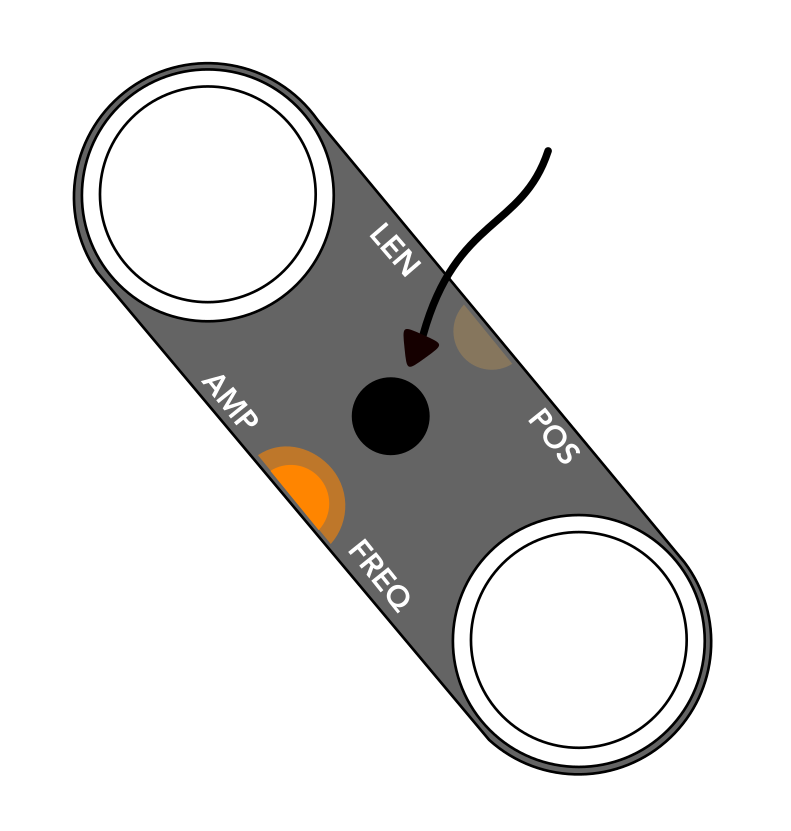
Frequency and Waveform
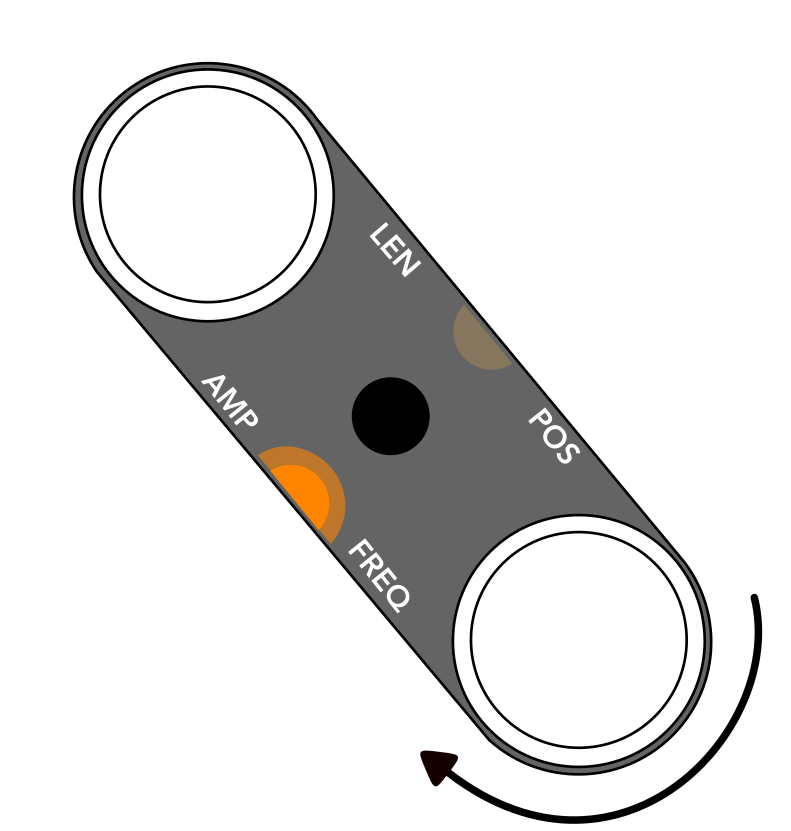
With at least one field selected, adjust the LFO's FREQUENCY and WAVEFORM using the bottom knob:
- Turn — increases the LFO's frequency
- Press — cycles between the five waveforms: sine, triangle, ramp, square, and random
Amplitude and Destination
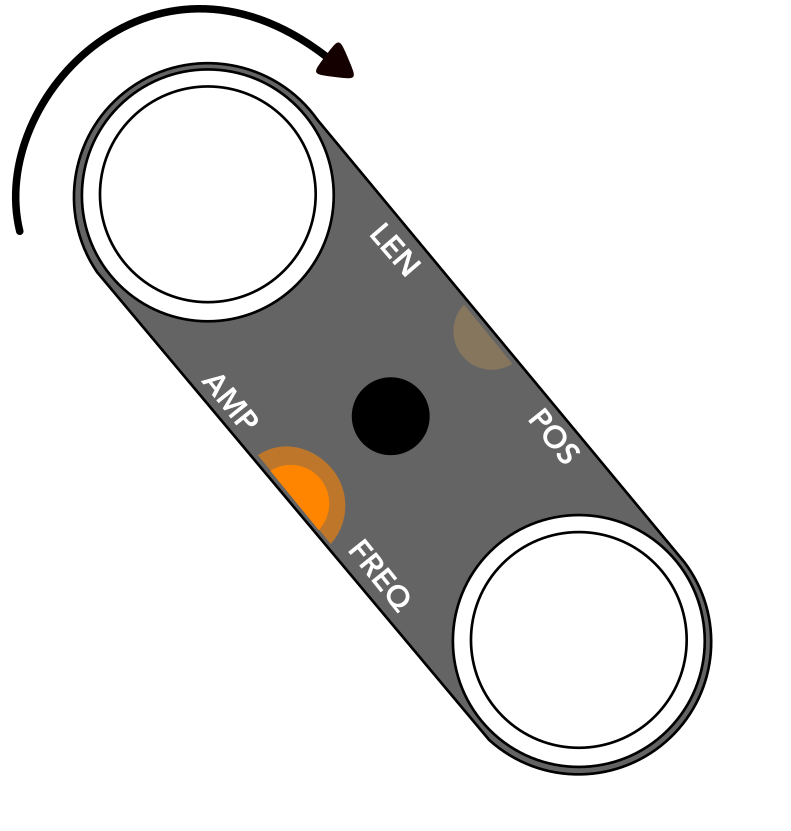
With at least one field selected, adjust the LFO's AMPLITUDE and DESTINATION using the top knob:
- Turn — increases the amount the LFO modifies the destination parameter
- Press — cycles between the three destinations: pitch, position, and length
Modulation Reflection
In a typical CV setup, when modulation exceeds the maximum parameter value, it clips. For example, if you modulate a filter's cutoff beyond the maximum, you simply hear the highest cutoff. When modulating position and length on the Haloplane, this is not the case. Instead, LFO values that exceed the maximum are reflected.
This opens up a few helpful possibilities:
- modulation increases always result in audible motion.
- the ramp wave becomes a downward saw if the base position or length is 100%.
- more complex LFO waveforms result when position or length is set to 25% or 75%.
What about pitch?
Pitch modulation does not reflect. The maximum modulation for pitch is ±12 semitones. That means you can do rhythmic melodic (octave) jumps by using a square wave LFO on pitch at maximum amplitude.