Micro-loop Sampling
By default, the Haloplane handles short recorded loops of sound. The source of these sounds can:
- Samples recorded directly using the microphone or audio input
- Sound files loaded through the companion app
- Presets or samples from the built-in library
Once a sample is loaded, or recorded, it is indefinitely and continuously looped.
There are three main ways to manipulate the micro-loop: its transposition, its length, and its position.
Transposition
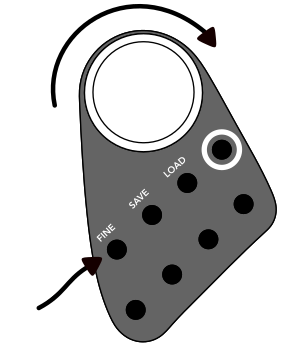
Transposition changes the playback speed of the loop: lower transpositions are lower in pitch, but also slower — higher transpositions are higher in pitch, but also faster. Each octave (-24, -12, 0, +12, +24) is double the speed of the last. There are a total of 4 octaves of transposition possible. Fine tuning by cents is also possible.
Length & Position
The length and position parameters on the Haloplane are unique. Veterans of other samplers might expect length to change the length of the loop and position to change the offset/position of this window: that is not the case.
Try the length and position sliders below to visualize how these parameters change the looped playback.
Length will change the number of slices (1 to 15) that the audio loop is split into, and the length of the loop as a result. Position crossfades from one slice to the next.
When length is at 100%, only one slice is present and the loop plays back in full; position has no effect in this case. Once length is reduced below 100%, a second slice is created — nearly at the full length of the loop — and position crossfades between these two slices. This process continues with smaller loops and additional slices being created. Once length is at its shortest, the single slice becomes a clear oscillation/tone. Position changes the timbral content of the tone.
The loop always crossfades back onto itself, so loop playback is always seamless. The loop can be reversed at any time by pressing the top right knob.
This unique sound engine sits between normal sampling, granular synthesis, and wavetable synthesis — but isn't exactly any of those things.